


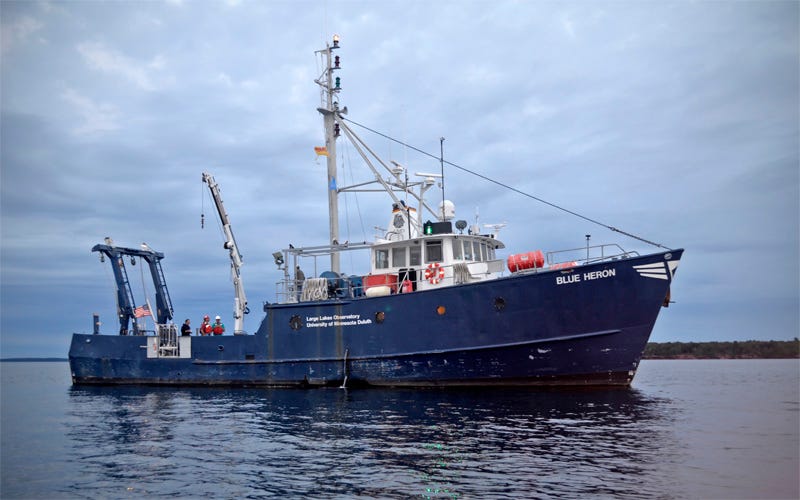
The water was cold and calm, the sun high and bright when we departed from Superior, Wisconsin. It was late May, and I had the privilege of accompanying the crew and science team aboard the Great Lakes research vessel the Blue Heron as it crossed Lake Superior. My goal for the trip was to better understand the role science vessels and researchers play in keeping the Great Lakes clean and healthy.
The University of Minnesota’s Large Lakes Observatory studies the major lakes of the world. It also owns and operates the Blue Heron. The Heron is the only Great Lakes research ship that’s also part of the University National Oceanographic Laboratory System (UNOLS). UNOLS provides the primary mechanism for coordinating access to the U.S. Academic Research Fleet which is supported through interagency partnerships like NOAA and the National Science Foundation. Operating costs are distributed among users based on utilization, with the NSF supporting approximately 70 percent of total US fleet usage. As part of the arrangement with NSF, the Heron is inspected regularly to ensure they’re doing science in an efficient and safe manner.
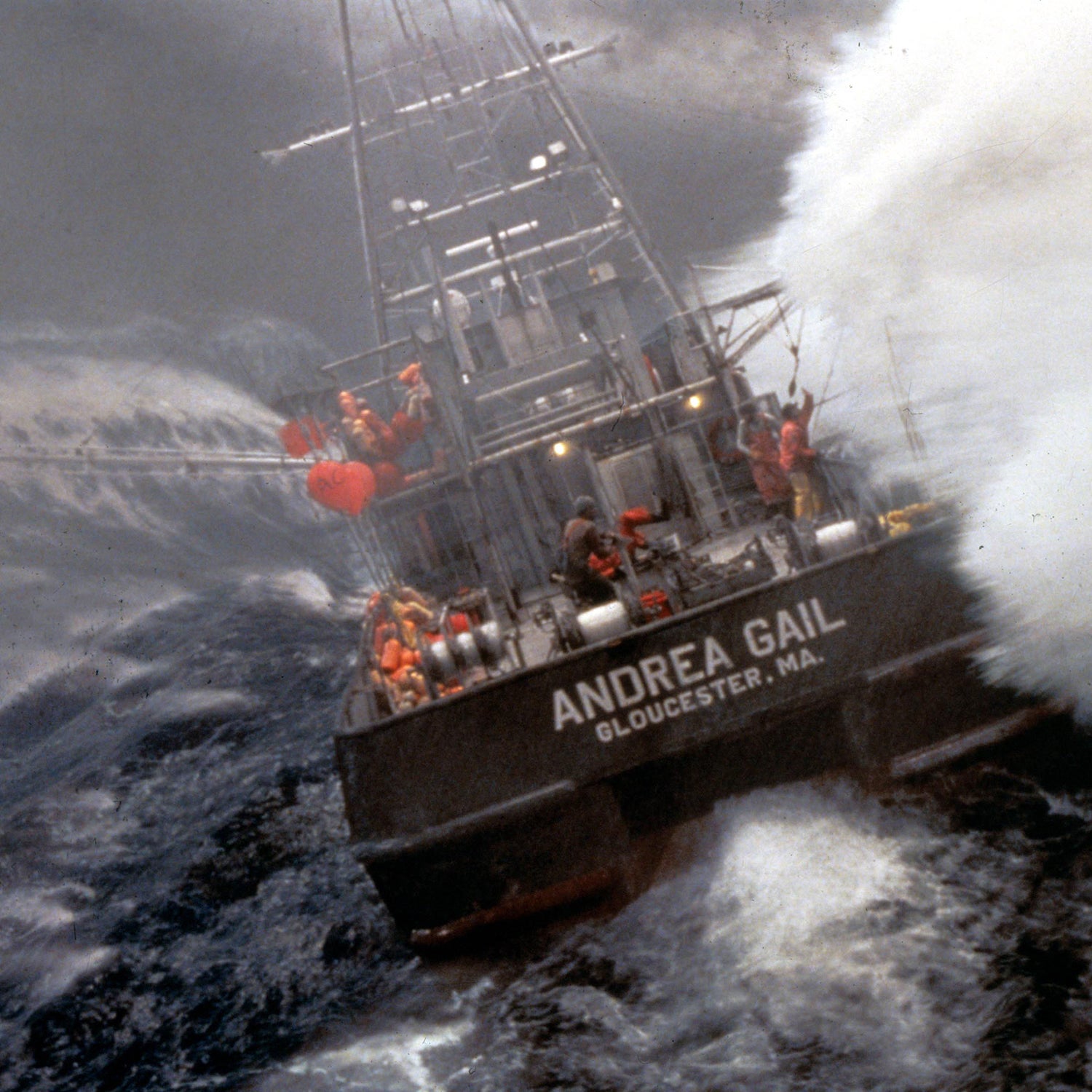
A sister ship of the fishing trawler featured in A Perfect Storm, the Heron is notable for discovering a new form of microbial life found oozing from its propeller shaft in 2025.
“We’re the largest university owned vessel on the Great Lakes, at least on the American side. As far as I can tell, we fill a very important niche. There are federal science boats that are very regimented in what they do. But we like to consider ourselves the Swiss Army knife of boats. We are able to do just about everything that a regional class or ocean class vessel can do on the Great Lakes, just in a smaller package,” said Blue Heron Captain for twelve years Rual Lee.
Before departure there was a safety briefing by Chief Mate Jay Hanson. After he walked us through the dos and don’ts, we trained in donning emergency immersion suits. In the rare event we needed to abandon the Heron, the orange waterproof dry suit would protect us from hypothermia in Superior’s cold water.
The Science Mission
Day one found us travelling along the spectacular beauty of the north shore of Lake Superior as the science team readied their instruments for data collection.
Tens of millions of Americans rely on the Great Lakes for their drinking water. The lakes are also economic engines. They generate $5.1 billion in fishing and $16 billion in the recreational boating industries. If it were its own country, the Great Lakes region would have a GDP of $6 trillion – making it the third biggest economy in the world.
“Compared to what we know about the oceans, we know very little about the Great Lakes,” said Rachel Flickinger, a PhD student in the University of Rochester’s Department of Earth and Environmental Sciences and a member of the science team.
“When you’re talking about twenty percent of the fresh water that’s available on the planet, it’s good to know what’s going on with that system and how it’s behaving with changes in the global climate,” Captain Lee said.
Professors John Kessler and Tom Weber from the University of Rochester’s Department of Earth & Environmental Sciences led the science team. Their aim was to measure and map the amount of the potent greenhouse gas methane – a major contributor to our warming atmosphere – emitted by all five Great Lakes.
“I’ve done between twenty-five and thirty of these trips so far,” Kessler said. In that time, the way they conduct research evolved. Early trips required samples to be hauled back to the lab for analysis, wasting precious time and resources. Because of the unique, customizable nature of the Blue Heron, Kessler and his team developed a system where they pump lake water continuously from the hull into their instruments as they sail from location to location. Instead of walking off the ship with a cooler of vials, they’re walking off the ship with a laptop filled with data. Their findings will help fill the gaps in the understanding of global emissions.
“We’re also out here to be educators,” Kessler said. “Half of our scientific team are students that we’ve brought out here. This is essentially a classroom, but we’re not doing lectures, we’re not doing homework assignments.”
“We’re giving students the opportunity to have hands on research experiences, conducting world class research on a world class research vessel,” Kessler added.
We hugged the coast because that’s where the highest concentrations of methane are. “Methane is the primary one that we’re interested in. But we’re also measuring oxygen levels, carbon dioxide levels, temperature, nutrients, chlorophyll, we’re getting GPS position, we’re getting some various atmospheric properties,” Kessler said.
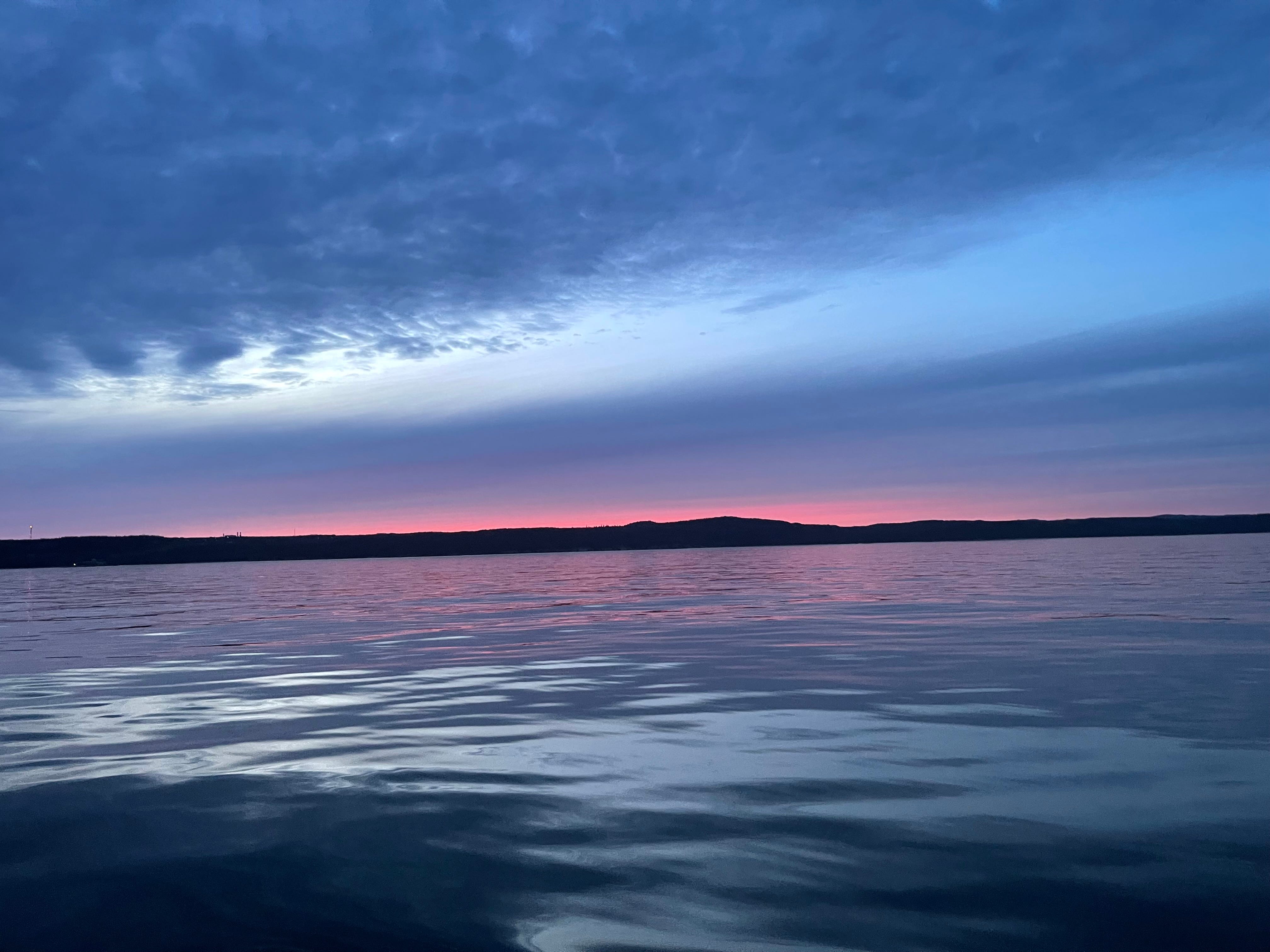
The importance of the greenhouse gas data they were collecting would be underscored weeks later as climate change fueled Canadian wildfires choked the very Lake Superior north shore we travelled along with thick black smoke.
I spent the rest of the day talking with the science team as they fine-tuned their instruments and began testing. What amazed me was how the two teams merged seamlessly into one. Everyone worked together for the broader mission. The sun set as we sailed by Hovland, Minnesota just south of the Canadian border.
Life Onboard the Heron
I expected a break in the day’s activities, possibly a sit-down dinner where we got to know one another and hear some stories swapped about close calls and weird happenings on the lakes—stories I could use for this piece.
What I hadn’t realized was the work and the ship never stopped. The Blue Heron kept on steaming through the night. Working in shifts, both the crew and the science team never ceased. 24/7 they would work like this. While I was only onboard for three days, they would tirelessly work for the next seventeen. And in tight quarters, there was an emphasis on being conscious of others’ need for space.

Not that without a formal dinner I went hungry. Quite the opposite. We were well fed by the Steward, Lisa Sundberg, the entire time. I even tried dumpling lasagna for the first time. And Lisa did so much more than cook for the ten of us. Some of the small but efficient crew had to wear many hats. Lisa’s also a highly trained mariner with EMT and firefighting certifications. From 1AM to 4 AM each night she also piloted the boat.
Since I was joining the five crew members and five-person science team onboard, space was at a premium.
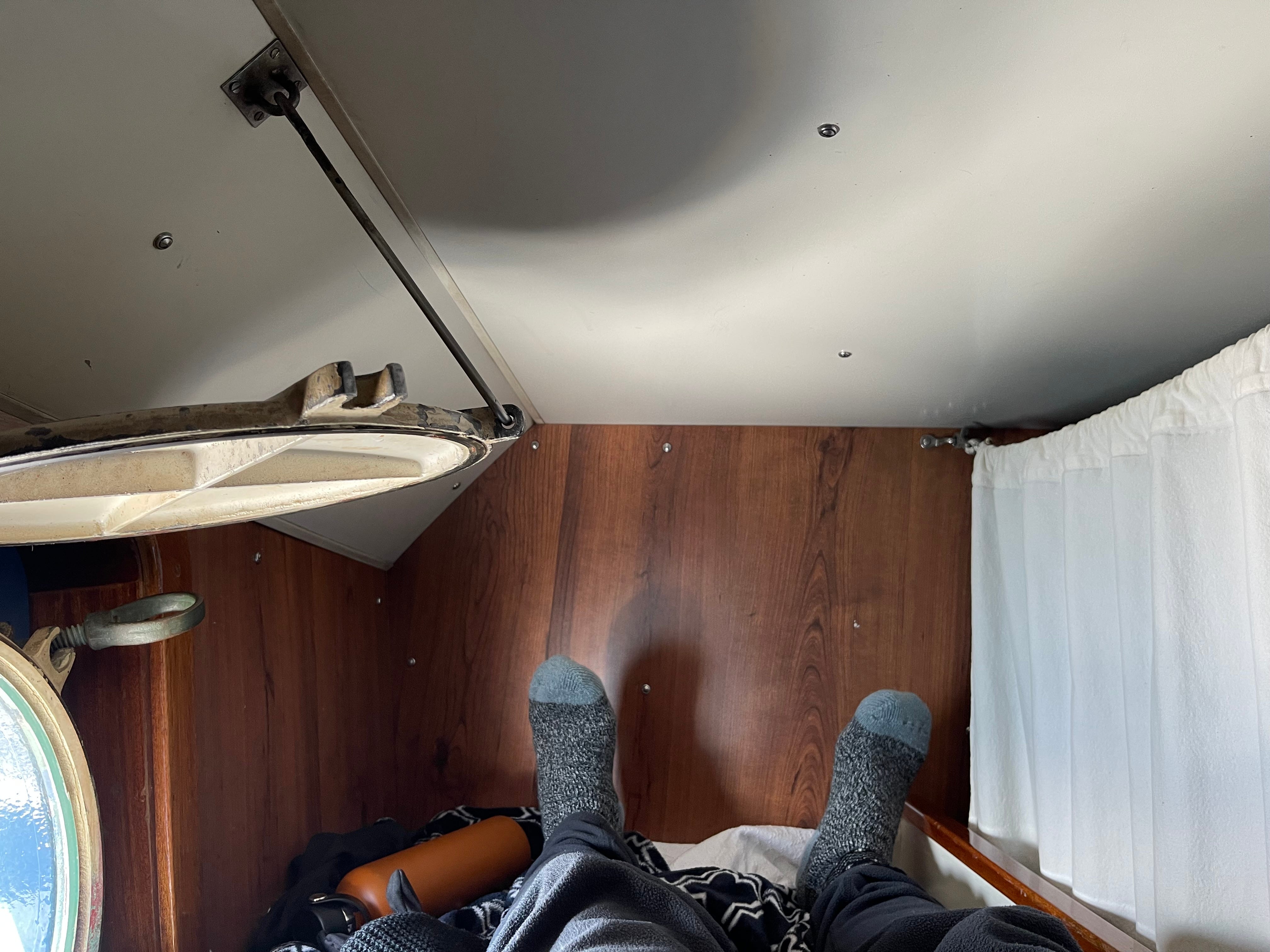
“We’re able to deal with a lot of weather, but this boat also has a lot of limitations because of its size. We would like to have more bunk space,” Lee said.
Indeed, I had one locker for my gear and clothes, and a coffin sized bunk to sleep in with a privacy curtain.
Nipigon Bay
I woke up and we’d crossed into Canadian waters by Edward Island, to the east of Thunder Bay. Because the weather was good, and the science team needed as much coastal data as possible, we travelled north. Our journey took us all the way to the 49th parallel and the northmost point of Lake Superior — Nipigon Bay.
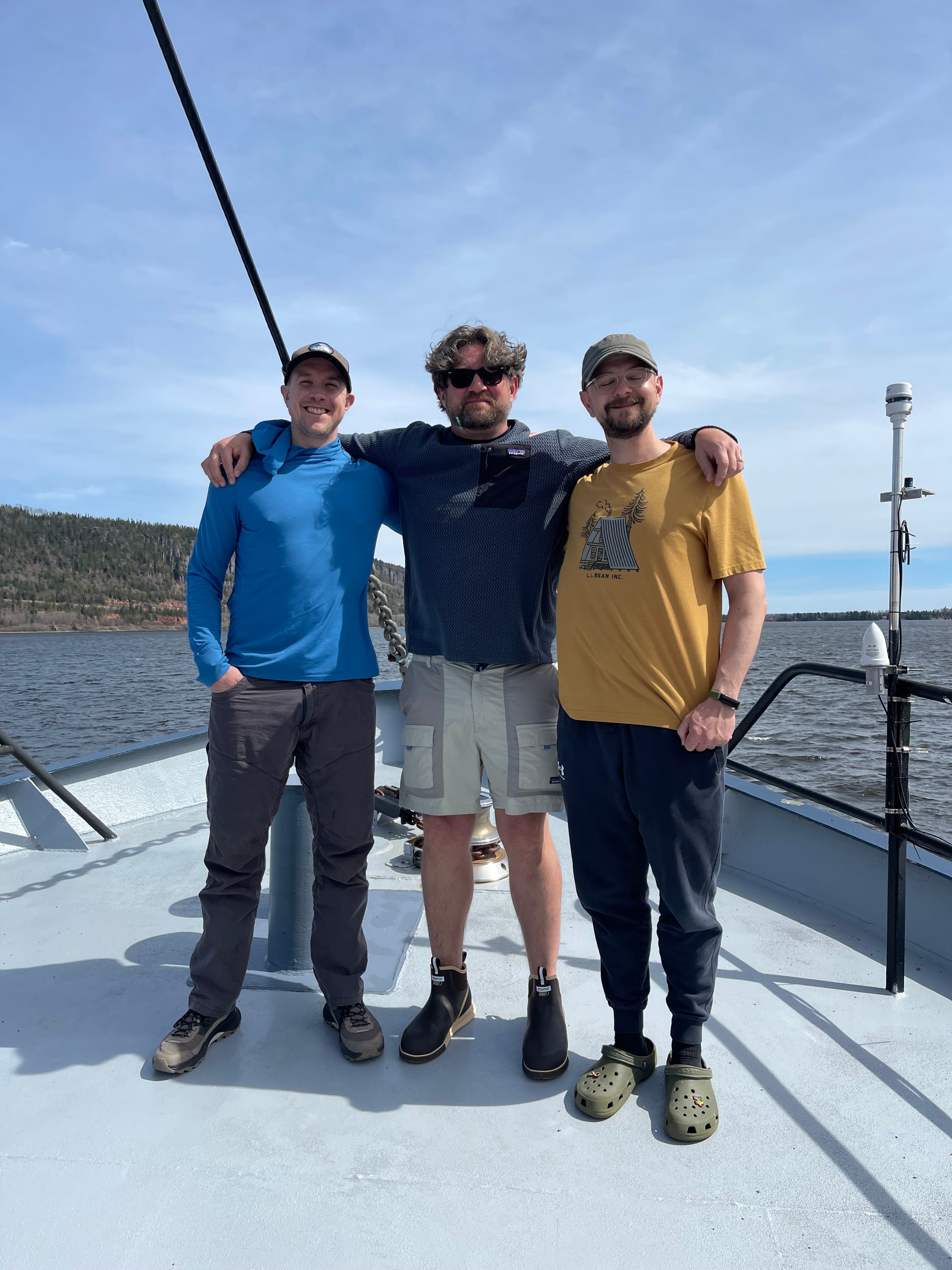
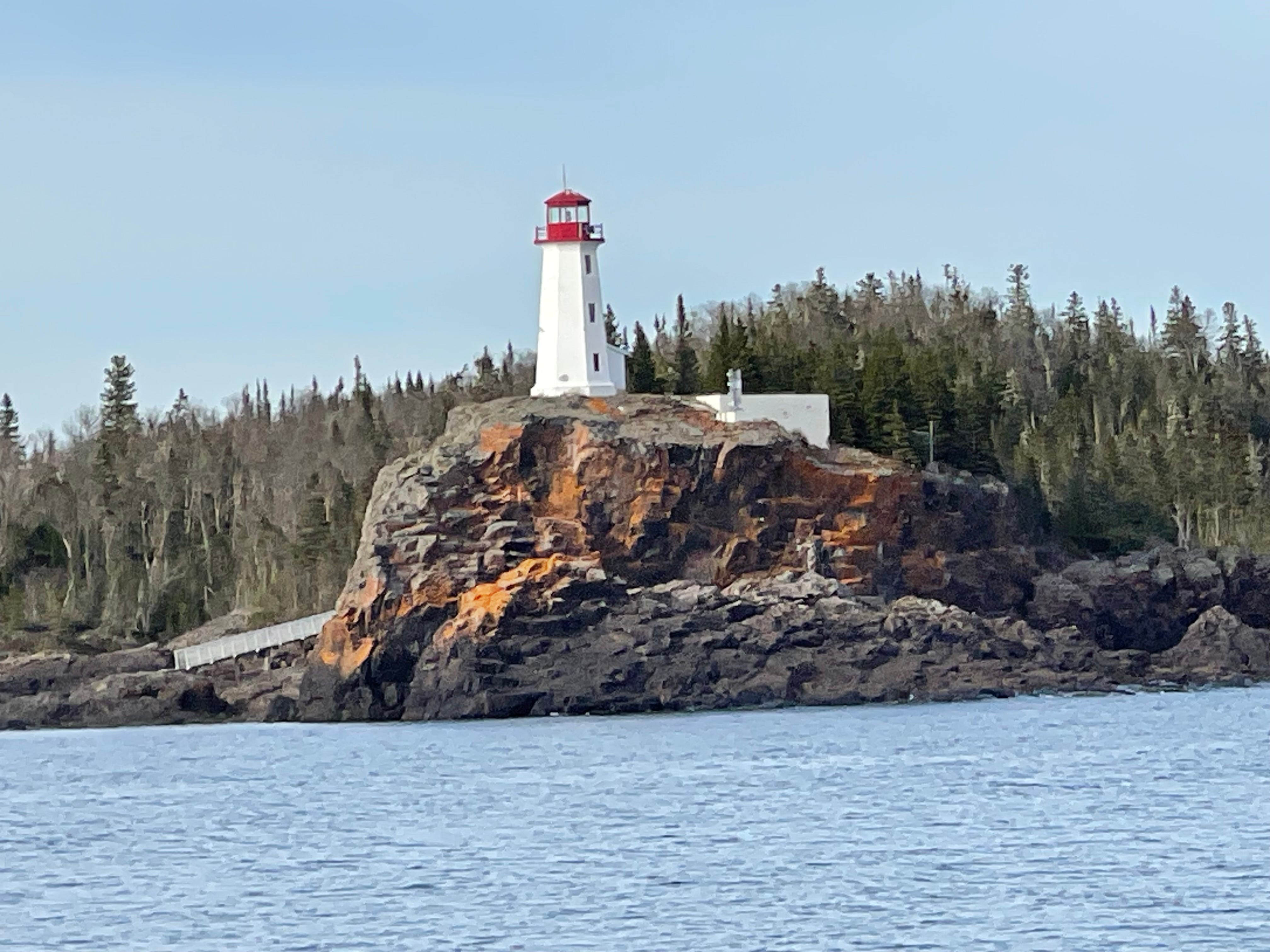
It was the only time the Blue Heron stopped. The captain let everyone out on deck to marvel at the beauty of this remote place. Although today it’s surrounded by dense forest and stubby hills, with a shoreline dotted with well-preserved historic lighthouses, Nipigon Bay wasn’t always a pristine natural wonder. Decades of industrial pollution and neglect plagued it like many other sites across the Great Lakes. On September 16th the Narwhal wrote about Nipigon’s recent turnaround.
“In the early 1970’s Canada and the U.S. joined together to create the Great Lakes Water Quality Agreement. In 1987, the agreement identified 43 official areas of concern. A dozen of those were on the Canadian side – including Nipigon Bay. In August, Nipigon Bay was officially delisted as an area of concern. Cooperation and a commitment to keeping the lakes clean had demonstrably worked.”
As the Heron turned South, I caught up with Max Wilder. Max came to Duluth after completing his graduate work in Syracuse for a postdoc that was supposed to be shared between the Environmental Protection Agency and the University of Minnesota Duluth, with the bulk of the work at EPA. According to Max, due to federal funding cuts and restructuring, his program was cancelled shortly after arriving in Duluth.
“It’s definitely not an ideal scenario for me personally or for the work that the EPA lab in Duluth was doing. A lot of great projects, a lot of great researchers have been sidetracked, forced to relocate, forced to reevaluate their career decisions and priorities. And at least from my perspective, for no good reason. There isn’t a real justification for it.”
Whitefish Bay
Late in the morning of my third and final day on the Blue Heron the weather changed. We’d had glass-like water for the entire journey. Now wind and rain had arrived. The waves got choppier and the ride bumpier as we headed toward Whitefish Bay and the Soo Locks.
“There’s two types of sailors on the Great Lakes,” Captain Lee told me. “Those who have been seasick, and those that will be seasick.” Having spent a lot of time on the ocean without once getting sick, I was skeptical. Lee explained that Lake Superior’s wind-driven waves bring a different kind of motion than ocean currents. It was motion that despite a neck patch of anti-seasickness meds, took me out of commission for four hours.
Once I had my sea legs under me again, I went onto the back deck to watch Rachel demonstrating how they extract methane from water samples in real time.
“I think something a lot of people don’t realize and I didn’t even realize growing up here my whole life. Most people’s water actually comes from the Great Lakes watershed in the Midwest. It’s also used for fishing, for shipping, for industry,” she said.
“And if we don’t study these lakes, we don’t study the impacts of what we’re doing, and we just let things happen to them without knowing this could impact everybody who lives in this region. If you take away the research, you may lose a lot of what we rely on to live in this region,” Rachel concluded.
It was nighttime when we arrived at my destination, the Soo Locks. The parallel locks enable ships to travel between Superior and the other Great Lakes and are managed by the US Army Corp of Engineers. The facility was brightly lit and glowed in the night sky. This is where I would leave the Heron. And true to form with the never-stop-working attitude of the crew and science team, my departure consisted of a thrilling thirty seconds where a chair was propped against the side of the Heron, I jumped to shore, was thrown my bags, and the ship steamed away on its mission.
In the end, it struck me that the research aboard vessels like the Blue Heron may seem far removed from the everyday lives of Americans. But I learned how the data collected on these expeditions helps answer questions that affect all of us. How are the lakes changing? What is driving those changes? What are the risks to communities and the environment? And what can we do about them? Answering these kinds of questions are foundational to understanding how to protect and preserve the lakes.